Broadly speaking, there are two types of startups I meet with as a VC: those reinventing an existing market and those creating a new one.

These two types of disruption are commonly thought of as distinct, but there’s actually a lot of fundamental overlap that goes unseen.

Take Uber. Which category does it fit into? The answer is not as simple as it may first appear. In the short term, they’ve reinvented an existing market (taxi-hailing). But their bigger vision in the long term is creating an alternative to car ownership.

Often, the bigger long-term opportunity is in creating entirely new markets. Transformative companies that create the greatest value often fall in this category.

But not every startup that ends up creating a new market starts out that way. Amazon began by reinventing the bookstore online. Using that as a beachhead, they have now created whole new market categories from e-readers (Kindle) to smart speakers (Alexa), while simultaneously reinventing cloud services (AWS) as well as shipping and logistics.

This essay is intended to help Founders identify and anticipate the nuances between reinventing an existing market and creating a new one so that they can accurately understand where they stand and what their right strategy is.

Not all startups begin with creating a whole new market and trade off market risk for execution risk. Other startups are truly staking out terra nova. Either path is viable; the important thing is to know which signposts to look for that indicate which path you’re on. In both cases, the scale of value creation that’s possible is consistently underestimated.

What Reinventing Existing Markets Looks Like


One of the biggest ways in which we continue to see existing markets reinvented is through digitizing and organizing existing offline behavior.

The covid era has accelerated digitization in every industry. This is most obvious in e-commerce, but it’s visible across the board — every part of life from going to the dentist (which now requires online booking) to eating at a restaurant (online reservations) has increasingly moved online.

One of the big lessons from digitizing offline behaviors is that if you incorporate a compelling network effect and embed some sort of payment or fintech component, what initially may look like a small niche business can eventually turn into something quite massive.

For example, many restaurants in the Covid pandemic don’t take walk-up diners and have moved the formerly offline activity of going to a restaurant partially online through platforms like OpenTable, which has a powerful 2-sided marketplace network effect and has built a business worth billions of dollars simply by digitizing offline behavior.

One of the biggest trends we are seeing is that offline behaviors are permanently shifting to online behaviors at an accelerating pace, and this presents continuing opportunities for startups reinventing new markets.

This trend of digitizing offline behavior falls under a broader framework that has stood the test of time: the formula for reinventing markets is to take a compelling new technology or approach and apply it to a specific industry.

Vertical search engines like Kayak and Trulia are examples from the early 2000s. Born in the wake of Google, which, at the time, represented a compelling new horizontal technology (i.e. search engines), they found success reinventing their respective verticals (online real estate and online travel) by applying search technology.

We saw many other examples of this in the first two waves of the internet, with mixed success. Zynga, for example, had the same idea (applying new social media tech to the gaming vertical), but they turned out to be too entrenched in the platform they were born from (Facebook) and incurred too much platform risk as a result.

Now, in the internet’s third wave, we’re seeing a similar formula with AI and blockchain applied to new verticals. In general, if you’re a startup doing something like “AI + mortgage”, it’s a sign that you’re in the business of reinventing existing markets. This approach can be a helpful way to start. The best companies are those that evolve their value proposition rapidly and develop a deep understanding of their customer.

While this is a tried and true formula, timing is key. If you’re a Founder looking for new startup ideas, how do you know which markets you might potentially target


One of the telltale signs that a market is ripe for reinvention is traditional advertising.

If you see a lot of advertising in a market category, that’s a good signpost that there’s significant product atrophy. Usually, advertising signals that existing players are competing for significant revenue, but they can’t rely on product differentiation and therefore they compete on ad spend.

Think about the amount of advertising that goes on in categories like automotive and insurance. Look out for this: where there’s large advertising spend is often the biggest opportunity for disruption.

Companies that recently went about reinventing the automotive and insurance categories — i.e. Tesla and Lemonade or Hippo — are now the largest companies in their industries by market cap by choosing to spend significantly on product development and not on advertising.


Why? Because they were able to reinvent the market, creating innovative and differentiated products in a market overcrowded with commoditized players.

However, Founders should keep in mind that reinventing existing markets isn’t all about product innovation; it’s often just as much about execution and go-to-market.

The near-term objective, if you’re a disruptive new startup, is to scale up distribution before the incumbent can copy you. The expectation for many startups and investors is that the incumbent has many structural advantages that will enable them to copy a new innovator. But if a startup is able to get distribution quickly enough, you should be much less worried about incumbents because their ability to innovate is generally weak and it’s quite hard for them to copy you.

Don’t Become What You’re Trying to Disrupt


While there is a danger of incumbents copying startups, I find that startups copying incumbents can often be an even bigger danger.

If you’re reinventing an existing market, don’t become what you’re trying to disrupt. For example, when Amazon was starting out, one of the biggest mistakes they could have made would’ve been going out and hiring a bunch of executives from the incumbents in the market they were trying to disrupt.

Imagine if the early leadership of Amazon had included people with long careers at Borders or Barnes & Noble. Those executives would have wanted to implement the same basic business model all over again.

The point is that this is a danger you should be aware of if you’re a startup reinventing an existing market: you might start out with a disruptive model, but end up getting pulled in the wrong direction to do things the same way as the market incumbents — which is less innovative and more about capturing pre-existing revenue.

This often manifests by hiring too many industry veterans. When I was at lastminute.com, we hired a lot of travel executives, and I felt this kept us too tethered to old ways of doing things. So when I founded Trulia, we deliberately didn’t hire people who worked in real estate. The more you fill the executive ranks with industry veterans, the bigger the risk that you’ll end up copying the incumbents too much to really reinvent the industry.

Startups can’t afford this. You have to think like a contrarianYou have to resist the temptation to follow the tried and tested. Startup innovation is all about venturing into the unknown and blazing your own trail

Frameworks for New Market Creation

As mentioned earlier, while reinventing existing markets is often a good way for a startup to start out, creating a new market is often where the real value ultimately lies. If you want to become a truly transformative company, it means creating a new market.

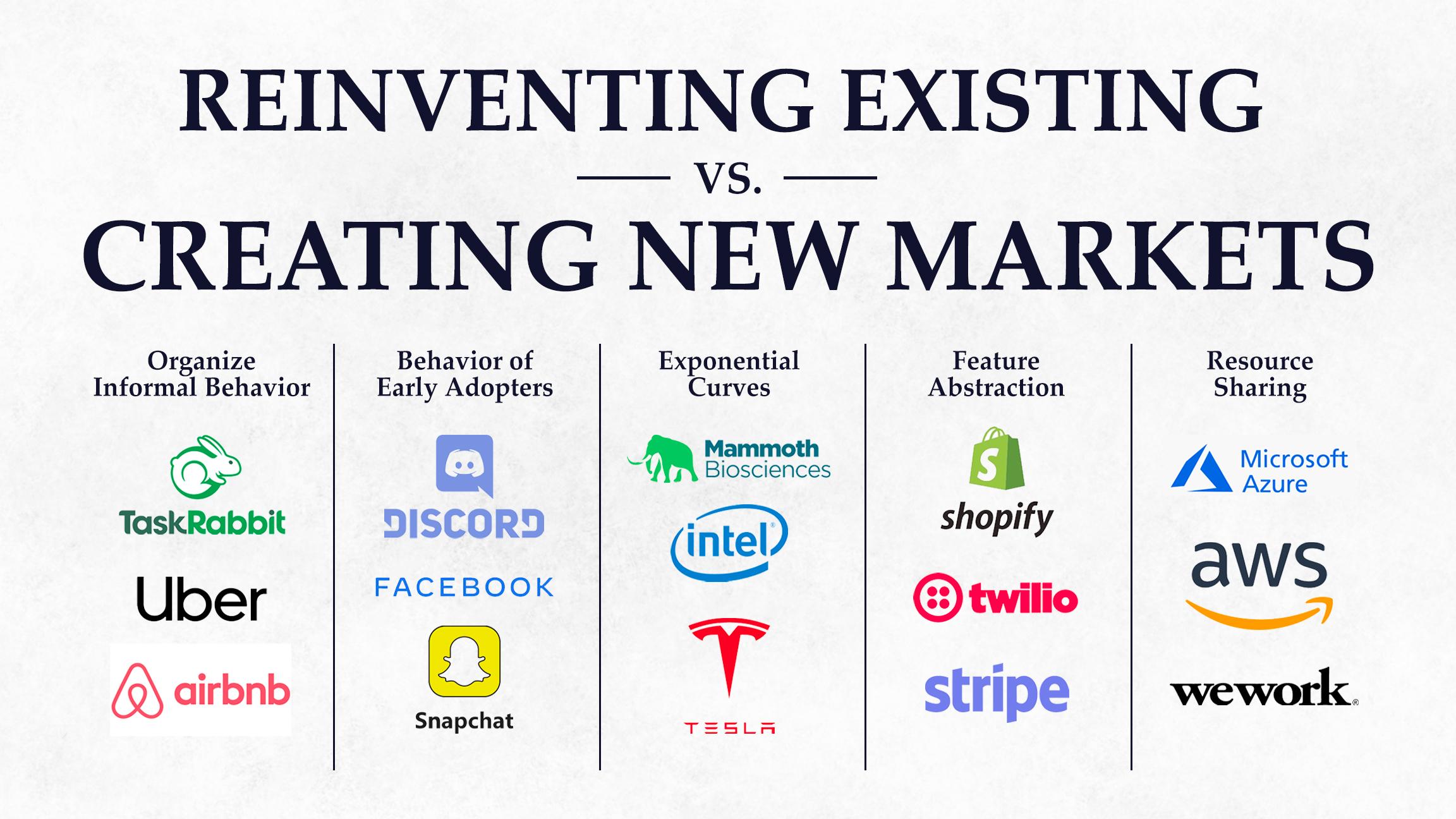
But that’s a daunting prospect. How do you even begin to think about this? To help structure your thinking, I want to offer 5 places to look for the potential to create new markets.

1. Organize Informal Behavior

Organizing previously informal behavior into something that can be done commercially and at scale is one place to look.

TaskRabbit, Airbnb, and Uber are all recent examples of this. In the early days of TaskRabbit, for example, one of the biggest use cases was getting rides at the airport — a previously informal activity that TaskRabbit was able to commercialize.

You see a lot of new market creation via organizing informal behavior in horizontal marketplaces, which often serve to unlock latent supply in a situation where there was previously constrained supply paired with large demand.

For example, Instagram, where you see influencers selling products that they use — a previously informal activity (people recommending products to their friends) that got organized, commercialized, and eventually professionalized, creating a new profession.

Wherever there’s a potential to organize informal behavior at scale, there’s a potential new market opportunity.

2. Behavior of Early Adopters

The behavior of early adopters of new technologies is often a good place to look for new markets.

One good prompt I like to use: look at what students and engineers are doing. These have been the leading archetypes of early adopters in the past because they have very dense social networks with a high propensity to discover, adopt, and disseminate new technology.

The hot new products that engineers use so often become the hot things that we all use — products like Discord and Slack. The same applies to students and young people, as we saw with Facebook, Reddit, and Snapchat, or new lifestyles like digital nomads.


The behaviors of students and engineers are leading indicators of new markets.

3. Exponential Curves

Another place to look for new market creation comes from either the exponential growth of a new adjacent market (e.g. the growth of the internet > e-commerce) or an exponential collapse of pricing (e.g. genomic sequencing for biotech, Moore’s Law for computing, solar energy cost for EV / clean energy tech).

The nature of exponential growth or collapse is such that it tends to happen much slower than we think, and then all at once. This can make the state of the market hard to judge because our intuition is linear — not exponential.

But exponential behavior is something you find again and again, and that often creates a breakthrough opportunity. Startups by design are able to attack fast-moving markets more quickly than incumbents. As we often say, speed is your number one advantage as a startup.

4. Feature Abstraction

Another framework that has been used for identifying potential new markets, particularly in B2B, has been feature abstraction, i.e. turning features or products into platforms. Shopify, Twilio, Stripe, and Snowflake are all examples of B2B businesses built around products that were initially features.

Engineers in a company solving a particular problem is a signpost for this. “Is this a feature, or is this a company?” is often a question we ask startups as investors. Often, it can be that this is just a feature, but sometimes a feature can become a company if the market need is sufficient.

Slack started off building an internal collaboration tool for a game. PagerDuty began as a notification service that is now a SaaS instant response platform for business IT departments and is valued as a billion-dollar company.

5. Resource Sharing

Turning fixed costs into variable costs is another place we often see new market creation. For example, WeWork turning office space from a fixed cost into a variable cost according to office space usage, or AWS doing the same for cloud storage.

A lot of the easy versions of this have already been done, but though the low-hanging fruit may have been picked there are likely still opportunities.

Consistently Underappreciated Opportunities


The framework I’ve outlined here is useful for thinking about where your startup lies between reinventing vs. creating markets, but keep in mind that it’s a spectrum, not a dichotomy.

Did Tesla create a new market (EVs) or reinvent an existing one (Automotive)? Rarely do companies fit into one category or another, and sometimes where you lie on the spectrum changes over time.

But it’s good to know where you are on this spectrum for a couple of reasons.

The first is about playing to your strengths. As a VC, if I meet a team with a lot of industry experience, they tend to excel at creating businesses that focus on reinventing an existing market because they have built up the ability to execute well over their careers and it makes more sense for them to take on execution risk.

On the other hand, the archetype for Founders creating new industries is that they’re often creative, technical, and positively naive (in a good way, as they lack industry experience which can be a double-edged sword when it comes to innovation). Founders who have success creating new industries are often people who are able to think from first principles and are outsiders with limited business experience, but with deep domain knowledge from a technical standpoint.

The second thing that’s important about knowing where you stand is recognizing that creating new markets often produces larger outcomes because they’re contrarian — businesses creating new markets are doing something much less obvious than reinventing existing markets by applying a new technology, which means that they rarely have much competition to deal with.

In either case, however — whether a startup is reinventing an existing market, or creating a new one — I’ve noticed that the TAM opportunity tends to be underappreciated.

In new markets, this is because it’s consistently difficult for people to visualize the value created by something new, especially when it comes from exponential growth or exponential collapse of prices.

With existing markets, many don’t see that when you digitize something and add network effects, your potential market share can be much higher and your margin structure can be much more favorable. So you can’t just look at the offline equivalent and extrapolate from there. The “restaurants booking” TAM is a completely different beast offline than it is online.

So while creating new markets often creates the biggest outcomes, no matter where you lie on the spectrum, if you understand this framework and play to your strengths, your startup will have a good chance of defining or redefining a category.

www.tmaragroup.com


Creating new market category leaders

Being 100% authentically African holds the secret kept from Africa for centuries. This understanding holds the key and within this lies the solution to a full life for all in Africa. The more we come to understand this, the more a life filled with purpose comes alive.

It was always thought that Africa is a continent of need, however it is us that needs Africa more; as in this understanding lies the purpose for Africa and only then does grace become a reality causing Africa to come alive and serve and ignite the world in ways never seen before

Unlocking the true value in Africa requires us to create rather than build, as building requires something to already be in place, however creating requires nothing. However saying this, we soon come to realize that creating is so easy yet so difficult as it is a function of being rather than ability. We strive in our daily African lives to achieve and our ability has a great role to play here. Yet resting in our being requires no performance, just being 100% authentically African.

It is this understanding that Africa is missing; yet already have to change the continent from within. All is where we decide to go, go left and all goes left however it might not be right in the left, but the power of creating is in that which we decide. Once this reality comes alive, then us as Africans will come to know that either way is right, the experience however is just less or more. This reality lays the foundation for Africa to come to the understanding that we can create.

We as Africans need to use the world to merely save time in accessing existing examples of capital use and not to use the world to teach us how to create as this lies within us already.

Making the change over in understanding is the challenge. Once we adopt an understanding of finding a way where there seems to be no way as the new way in Africa, then from within this new understanding power and provision is birthed in abundance and the face of Africa will never be the same again.

For centuries we have been told that we are not worthy and that we do not have what it takes to experience a full life. And for most of Africa this lie has become the reality. The time has come for Africa to break the shackles of our own understanding and lead a new era of coming together in new relationships as the new way for Africa and serving our way into abundance and provision is a new way very few has ever experienced.

Message to the rest of the world:

We as Africans invite you to go big as Africa is not small, this is Africa and not you, the big is not big in your understanding, but big in Africa’s splendor. The result of Africa’s bigness is then only manifested in awesomeness in people; they can’t touch but will only experience Africa. Then only is big great.

Regards
Derrick de Necker

Written in 2017 and updated in 2023

Elon Musk explains why his daughter can’t marry a poor man.

A few years ago there was a conference in the United States on investment and finance.

One of the speakers was Elon Musk and during the question-and-answer session, he was asked a question that had everyone laughing.

If he, the richest man in the world, could accept that his daughter marry a poor or modest man.

His answer can change something in everyone.

Elon Musk – First of all, understand that Wealth does not mean having a fat bank account. Wealth is primarily the ability to create Provision and a Purpose-filled Life.

Example: Someone who wins the lottery or gambling. Even if he wins $100 million, is not a rich man: He is a poor man with a lot of money.  That’s the reason why 90% of the lottery millionaires become poor again after 5 years.

You also have rich people who have no money.

Example: Most entrepreneurs.

THEY are already on the road to wealth, even though they have no money, because they are developing their financial intelligence and the way they ‘show up” and that is wealth.

How are the rich and the poor different?

To put it simply: The rich may die to become rich, while the poor may kill to become rich.

If you see a young person who decides to train, to learn new things, who tries to improve himself constantly, know that he/she is a rich person.

If you see a young person who thinks that the problem is the state, and who thinks that the rich are all thieves and who criticizes constantly, know that he is a poor person.

The rich are convinced that they just need information and training to take off, the poor think that others must give them money to take off.

In conclusion, when I say that my daughter will not marry a poor man, I am not talking about money. I’m talking about the ability to create provision in that man.

Excuse me for saying this, but most criminals are poor people. When they are in front of money, they lose their mind, that’s why they rob, steal etc… For them it is a grace, because they don’t know how they could earn money by themselves.

One day, the guard of a bank found a bag full of money, he took the bag and went to give it to the bank manager.

People called this man an idiot, but in reality this man was just a rich man who had no money.

One year later, the bank offered him a job as a receptionist, 3 years later he was a customer manager and 10 years later he manages the regional management of this bank, he manages hundreds of employees and his annual bonus exceeds the amount he could have stolen.

Wealth (Provision) is first of all a state of mind.

So … Are you rich or poor?

BLESSINGS!!!🙏🏽

Credit to Author unknown

Please listen here first:


To create anything meaningful, particularly innovating for the market – the approach to one’s thinking is paramount.

Warning to innovators: EXPLAINING one’s innovation by analogy is helpful, but THINKING by analogy is limiting…. Here is more context:

Thinking by ‘analogy’ and thinking by ‘first principles’ are two distinct cognitive approaches used for problem-solving and decision-making. Let’s explore the differences between them:


Thinking by Analogy:


Thinking by analogy involves drawing parallels between a current problem or situation and a previously encountered one. It relies on the assumption that if two situations share similarities, solutions that worked in the past might also be applicable to the present problem.


Here’s how it works:


Identify a problem: When faced with a new problem, the thinker looks for similarities with other situations they have experienced or learned about.


Find an analogous situation: The thinker then searches for a previous situation or concept that shares similar key characteristics with the current problem.


Apply a solution: Based on the similarities identified, the thinker applies the solution or approach that worked in the analogous situation to the current problem.


Pros of Thinking by Analogy:


Quick problem-solving: It allows for rapid decision-making since it relies on pre-existing knowledge and solutions.


Requires less effort: Compared to thinking from scratch, thinking by analogy saves cognitive effort and time.


Cons of Thinking by Analogy:


Limited creativity: It may hinder thinking beyond familiar solutions and restricts innovative problem-solving.


Risk of incorrect assumptions: Analogies might not always be appropriate, leading to mis-judgments if the two situations are not truly analogous.


Thinking by First Principles:


Thinking by ‘first principles’ involves breaking down a problem into its fundamental components or basic principles and reconstructing a solution from the ground up. It requires questioning assumptions and understanding the fundamental truths underlying the problem. Here’s how it works:


Analyse the problem: Instead of relying on prior knowledge, the thinker examines the problem at hand without any preconceived notions.


Identify fundamental principles: The thinker identifies the core principles or basic truths that govern the problem.


Create a new solution: Armed with the fundamental principles, the thinker builds a solution or approach that fits the specific context of the problem.


Pros of Thinking by First Principles:


Innovative solutions: It encourages creative problem-solving by challenging conventional wisdom and encouraging unique ideas.


Deeper understanding: By dissecting the problem into fundamental elements, thinkers gain a more profound comprehension of the issues they face.


Cons of Thinking by First Principles:


Time-consuming: This approach can be more time-consuming and mentally demanding as it involves starting from scratch.


Requires expertise: It may require a deeper level of subject knowledge and expertise to identify the first principles correctly.


In summary, thinking by analogy relies on past experiences and similarities to find solutions, while thinking by first principles involves breaking down problems to their fundamental truths to derive innovative and context-specific solutions. Both approaches have their merits and limitations, and the choice of method often depends on the complexity of the problem, available resources, and the thinker’s preferences or expertise.


‘First principle’ thinking is particularly effective at creating new value and driving innovation for several reasons:


  1. Challenge assumptions: First principle thinking encourages individuals to question the assumptions and limitations inherent in existing solutions or systems. By doing so, it opens up opportunities for new perspectives and ideas that go beyond traditional boundaries.


  1. Unleash creativity: By breaking a problem down to its fundamental elements, first principle thinking allows for more creative problem-solving. It enables thinkers to explore a wide range of possibilities and come up with novel approaches that may not have been considered before.


  1. Foster innovation: Innovation often stems from challenging the status quo and finding unconventional solutions. First principle thinking provides a framework to approach problems with a fresh mindset, leading to innovative breakthroughs.


  1. Overcome limitations: Analogies are useful for leveraging existing knowledge, but they can also be limiting if the current problem requires a completely different approach. First principle thinking empowers individuals to devise solutions that are tailored to the unique aspects of the problem at hand.


  1. Address complex problems: Some problems are so complex that there might not be direct analogies available. First principle thinking allows thinkers to tackle these challenges systematically, starting from the foundational principles and gradually building up solutions.


  1. Adapt to changing circumstances: Analogies might work well in familiar contexts, but they may not hold up in rapidly changing environments. First principle thinking equips individuals with the ability to adapt and develop solutions for new and evolving challenges.


  1. Transform industries: First principle thinking has historically been behind some of the most significant breakthroughs and disruptive innovations across industries. By reimagining the fundamentals of how things work, it can lead to transformative changes and the creation of entirely new industries.


  1. Address efficiency and optimization: First principle thinking can help identify inefficiencies and redundancies in existing processes or products. By re-evaluating the fundamental components, thinkers can streamline operations and create more efficient systems.


  1. Encourage entrepreneurship: Entrepreneurs often use first principle thinking to identify market gaps and build unique solutions that cater to unmet needs. It serves as a foundational approach for developing ground-breaking products and services.


Overall, while thinking by analogy is valuable for drawing from past experiences and established solutions, first principle thinking offers a powerful toolset for generating new value, fostering innovation, and driving meaningful change in diverse domains. By understanding the underlying principles and rethinking assumptions, individuals can push the boundaries of what’s possible and create transformative solutions with a lasting impact.


First Principle thinking example: Why Bezos started selling books online

An important component of first principles thinking is the idea of consciously favouring first principles over analogy. Now, what does this exactly mean?


Well, you see, an analogy is when you compare a system with another system to point out marginal similarities between them. When you develop something through analogy, you only think of marginally improving an existing system rather than tackling the core problems with it.


Henry Ford, CEO of Ford Motors, described it perfectly — “If I had asked the public what they wanted, they would have said a faster horse (instead of a car!)”

Jeff Bezos, back in 1994, had a similar choice. While working at a hedge fund, Bezos realized that internet usage was increasing by 2000% every year. He needed to get into the WWW action. So, he decided to sell books on Amazon.com!


Now, he could either land on the analogy approach or take the first principles approach. Let’s explore them both!


Marginally improving on an analogy ⇒ Here Bezos could have started a physical bookstore holding book inventory in a storage facility and used the internet to reach more users. So, essentially, he would only slightly improve the traditional bookstore model by adding the “selling online” component to it.


But, instead, he did something very different!


Thinking from First Principles ⇒ Bezos identified that there were 2 fundamental problems limiting the profitability of these physical bookstores:

  1. Inventory cost
  2. And, the fact that these bookstores only sold bestsellers, as it was impossible to hold all books in any one store

Amazon’s model solves both of these problems. It was able to sell ALL books on the platform without holding any inventory. It just worked as a connecting tool between the book vendors and the end users.


With this model, Amazon’s growth potential became essentially endless. And, its trillion-dollar market value is a huge testament to that.


Applying first principles to the start-up (innovation) world in general:


To achieve the next level of performance, one has to move beyond thinking by analogy.


There is only one way to move beyond analogy, and that is to find the first principles that govern the creation of great companies. 


The first principle way, is far more powerful , because it enables us to create new realities. 

By default, it enables creating (finding, co-creating and funding) New Market Category Kings.

To realise the full benefit of the new way, one does however need to adopt a new rule set, in order to move away from educated guessing, and towards rigorous testing (against the first principles)


The first principles governing this early-stage space, have been discovered and codified, and a new way scientifically re-engineered, resulting in a new path for start-ups to become New Market Category Kings.


Today, a virtual factory-style Market Category Creator (MCC) is therefore able to answer the two “IF and WHEN, the Start-Up will take-off” questions for LEAD investors, that were previously impossible.


Furthermore, as an early-stage LEAD investor, if you’re able to gain the critical, non-consensus intel on New Market Category Kings earlier, AND you’re an ‘insider’, then you’ll neutralise the negative effects of the (governing) power law, and beat the market.


The rewards of being a successful LEAD (intrinsic value) investor, means consistently beating the market, and showing great returns.


In other words, if you command the first principles that govern the space of early-stage venturing and investment, then you’ll know  IF and WHEN, the Start-Up will take-off (before it becomes obvious to others).


The 2 first principles governing the creation of new market category leaders:


1) The innovation must have the power to remove a significant limitation (not just solve a problem) for the target market, and


2) The market must adopt a new set of rules, to realise the full value.


Thinking this first principle way is a departure from the norm, where inventors, entrepreneurs and founders of Start-Ups, are mainly focusing on merely solving problems, satisfying needs and just giving instruction of how to use it.


www.tmaragroup.com for creating new market category ‘must-haves’ through first principle thinking.


Example Source: https://buildd.co/product/examples-of-first-principles-thinking

Please listen here first:


“What is a unicorn, daddy-preneur?”

“It’s considered a start-up that quickly became a market MUST-HAVE and capitalized upon it ( the “it” being their perfect product-market fit), to become highly prized as a start-up, in a short space of time.”

“Where do MUST-HAVEs like these come from, dad? “

“They do pop up unpredictably in the start-up world from time to time, but today they can be made in a MUST-HAVE factory, where new innovations are turned into market MUST-HAVEs reliably, daughter-preneur!”

This MUST-HAVE factory has developed a scientific way to assess and affect a perfect product-market fit, the primary ingredient or DNA used for producing MUST HAVEs – the essence of a unicorn.

Worth noting, no (mere) NICE-TO-HAVE ever became a unicorn.

The factory has been developed and built, because it’s architects have found a way to consistently overcome the primary limitation (faced by most of their start-up clients), which is the elusiveness nature of their market’s sweet spot.

This sweet spot, when located and hit with an un-refusable offer, makes for a perfect product-market fit – as is can be assessed and produced in the product-market fit / MUST-HAVE factory today.

MUST-HAVEs by definition “reach product-market fit”, and “is the only thing that matters”, says Marc Andreesen.

It also accounts for the fact that 25 year olds are successfully running billion dollar companies.

Reach product-market fit, and the market pulls (almost) regardless of leadership.

If the market pulls, it forgives most other start-up sins.

And reaching product-market fit, means your start-up innovation, business model and market offer have met your market at their MUST-HAVE level, and the market then pulls.

And to become a MUST-HAVE, like Uber, Dropbox etc, your offering must have exceeded the market’s perception of MUST-HAVE value.

Essentially therefore, making the Market’s MUST-HAVE value , more important than your MVP.

So let’s unpack the creation of this MUST HAVE Value.

It’s a 3 stage methodology that converts a NICE-TO-HAVE innovation into a market MUST-HAVE, and brings accelerated market adoption and enhanced valuations for the start-up

Stage 1: Intrinsic Value:

An innovation can bring MUST-HAVE-type value, if and only if, it diminishes a significant limitation for the market.

Find the limitation (not addressing a known need, problem or want which are only symptoms) your innovation removes, and you have found the market’s sweet spot of MUST-HAVE proportions.

Stage 2: Realised Value

The market must change its existing behavior, or rules, to benefit from removing the limitation.

Find and adopt the new behaviour (the new rule) , and you’ve found the key to unlock market value that MUST HAVEs must command.

Stage 3 Guaranteed Value

Then innovations need a catalyst, to accelerate the rate of market adoption.

This guaranteed value is all about ‘walking the talk’.

If you guarantee the right market value, you find your market stickiness, you become ‘the rule’, the Uber of your industry, the verb and the MUST-HAVE.

So how do you know if you have reached product-market fit?

Well if you’re asking the question, then you have not! Here’s why…

What is Product Market Fit?

We can answer this question from four perspectives:

Market perspective = Product-Market Fit is achieved the moment your new product offering become a market MUST HAVE.

Start Up perspective = Product-Market Fit is achieved when your Minimum Viable Product(MVP) satisfies the Minimum Viable Value(MVV) of the market.

Funder perspective = Product-Market Fit is a tipping point (without it is hard to succeed, with it is hard to fail)

Scientific perspective = The moment the activity of attracting and retaining customers is no longer the weakest link or prime constraint.


How do Start-Ups go about ensuring they can achieve PMF ?

Let’s start with a statement “ The man who grasps principles can successfully select his own methods. The man who tries methods, ignoring principles, is sure to have trouble.” 

We can answer this question from two perspectives:

If you ignore principles – Then HOPE and Determination might take you all the way. There is no clear cut recipe. The odds are against you. If you grasp principles – Then FOCUS and Confidence can take you all the way. There is a clear cut recipe. The odds are in your favour.

  • Step 1 = Check if your idea or new product innovation can become a MUST HAVE

Define your target market’s Minimum Viable Value Specification – “Must HAVE Spec”

  • Step 2 = Check if your MVP can physically perform to the 10X level required to enable the MUST HAVE

Define your MVP’s feature set that will enable the market to adopt and sustain the new way

  • Step 3 = Check if your OFFER can meet the Guarantee Value level required for the market to adopt the MUST HAVE.

Define your Value Guarantee That Counts (High conversion)

  • Step 4 = Check if your TRACTION can meet the PMF level required to become the MUST HAVEof the market.

Define your telltale signs (tipping point) as designed by the MUST-HAVE factory.

So let’s sum it up:

MUST-HAVEs convincingly overcome the early start-up constraint of low or slow market adoption, by raising the perception of value in the mind of its target market, to the level of a MUST HAVE.

To raise the innovation to a MUST-HAVE level, a market offer or more precisely, a Value Guarantee That Counts (VGTC), is used as the catalyst. And boy-o-boy, a VGTC does count! The market pulls and word of mouth becomes more effective than the start-up’s own sales team and paid marketing.

A VGTC constructed scientifically to achieve a perfect product-market fit, can be tested that it truly hits the sweet spot, and based on its established sales hit rate, the start-up can then rapidly build the business, hire and attract investment accordingly, in line with the new MUST-HAVE.

So what goes into VGTC and how reliable is the MUST-HAVE factory process?

Well there are only 2 principles, as discussed above, that the innovation must comply with, to become a MUST HAVE, and we use this lens through which to assess and then affect the product-market fit

And at the assessment stage: it’s now possible to scientifically determine if you’re sitting on a MUST HAVE or not, and we do this by seeing if it complies to these 2 principles. If so, we then scope out the MUST-HAVE spec. and ultimately assess if it’s possible to create a VGTC which can be offered to the market, that will raise the innovation a proven MUST-HAVE.

This MUST-HAVE factory exists, and has assessed hundreds of hopeful start-ups from around the world, assisted plenty towards product-market fit, and has invested in nearly a portfolio which have become market MUST HAVEs..

Call us today, if you believe you may have a potential market MUST-HAVE, and want to assess and realise it.

MUST HAVE a conversation?

Please contact TEAM TMARA or register online for a 1 hour knowledge-sharing session.

www.tmaragroup.com


Virgil once proclaimed, ” Lucky is he who has been able to understand the cause of things.”

Said another way, ” Lucky is he who knows WHY”.


Please listen here:


Successful start-up pundits claim to get better at predicting the winners by adopting a portfolio strategy. Their pattern recognition certainly gets better with experience, but let’s be equally frank, even the very best early-stage players still can fail up to 19 out 20 times (granted – respectfully- we’re talking really early stage).
WHY?


Because “Correlation (pattern recognition) falls way short of causation”. Causation is a different category of (scientific) thinking, with a different starting point, different journey and vastly different outcome.
What’s the difference! The rooster’s crow is highly correlated with the sunrise; yet it does not cause the sunrise”, says Judea Pearl in his award winning THE BOOK OF WHY.
Pearl goes on say to say that data is dumb – it can often explain WHAT happened, but not WHY. Data does not understand Cause and Effects (THE WHY), people do, he says.
       
So here’s what we’re highlighting…if one is able to transition from the correlation (pattern recognition) world to the causation (scientific cause-and-effect) world, your odds of knowing WHY something is caused, improve by a magnitude.
Here’s HOW?


If one acquires and commands the few fundamentals that govern this early-stage space (through science), then one is able to CAUSE or CREATE successes. In other words, know WHY a venture is likely to succeed (or fail) well before momentum and/or consensus kicks in.
The fundamentals have been discovered,  the science now codified, and for the very first time, 2 key questions can now be answered rationally ….IF and WHEN……IF success is actually a potential outcome (before there is traction),  and WHEN will it succeed.
Virgil again, ” Lucky is he who has been able to understand the cause of things.”
WHY is your startup going to be successful?
#beamusthave 
Two related articles for further context:
 

“There are three tasks required  for creating a new category / subcategory…

  1. A firm must manage that subcategory so that it wins the subcategory battle. Subcategory energy, appeal and associations need to be conceived and communicated. Customers need to be knowledgeable about the subcategory and motivated to first make the decision to buy into the subcategory and then the brand, not the other way around. 
  2. A firm must also win the brand relevance battle. When the subcategory is the focus of a buying decision, the goal is to have your brand be the only one that is visible and credible with respect to delivering “must haves.” If your brand is not the only one, it should be the most relevant.

  3. The subcategory creator/exemplar brands need to build barriers to prevent competitors from gaining visibility and credibility, and thus relevance in the new subcategory. Creating a subcategory will not be valuable if competitors can become relevant or even appear to be relevant to the new subcategory. The barrier need not be technological. It can be anything that inhibits competitors such as scale, brand equity, value guarantee, customer loyalty and more.”

#beamusthave

When people are told to not think of an elephant, they can’t get the image out of their minds.

When President Nixon said he was “not a crook” what emerged was a reaffirmation that he was a crook.

So, it is necessary to be disciplined to consistently use the language of YOUR frame and never accept the alternative (THEIR frame).

Know that facts don’t really matter.

“It is a myth that people are rational and that some well-presented facts will change their frame-anchored view.”


“Successfully creating a new category or subcategory involves — in addition to finding a concept and introducing it into the marketplace — the active management of customers’:

  • perceptions,
  • attitudes and
  • behaviours toward it.”


Remember.. first, we are building a market, then a business.


THE (SUB) CATEGORY BATTLE-PLAN:

  1. Win the (sub)category battle  Provide unique customer MUST-HAVE(s)

      2. Win the brand relevance battle  Only we can deliver the MUST-HAVE(s)

      3. Win the competitor battle  No significant competitor, by default.


FRAMING!

#beamusthave

www.tmaragroup.com